


 Joe Capozzi
Five feature films, 64 shorts will be shown Nov. 7-9 at second annual movie festival in West Palm Beach.

Amateur snake hunters and the late Marjory Stoneman Douglas star in timely documentaries about the Florida Everglades headlining the second annual Subtropic Film Festival this weekend in West Palm Beach.
The three-day fest kicks off Nov. 7 at the Norton Museum of Art with a red-carpet screening of “The Python Hunt,” an engaging look at an eclectic group of misfits competing in Florida’s annual state-sponsored invasive python removal contest — “the Burning Man of snake hunting,” as one film participant calls it.
“River of Grass,” an impressionistic take on Douglas’ legacy and the ongoing fight to stop manmade threats to the Everglades, gets a matinee screening Nov. 8 at the Norton’s Stiller Auditorium.
Aside from the two Norton Museum screenings, the rest of the festival takes place Nov. 8-9 at Afflux Studios on the G-Star School of the Arts campus. Three other feature films and 64 shorts will be screened there, along with workshops and panel discussions.
While “The Python Hunt” and “River of Grass” are different in tone and style, both shine a spotlight on events past and present affecting the Everglades, the largest mangrove ecosystem in the Western Hemisphere but only half the size that it was a century ago. The latest Everglades assault is the Alligator Alcatraz immigrant detention center that opened in June.
“The entire world is looking at the Everglades right now,” said Noelia Solange, director of the Subtropic Film Festival. “The least we can do is aim the spotlight on the stories being told about this ecosystem and hope locals leave the film screenings with a deeper understanding of their own backyard and what they can do to take better care of it.”
In conversations with Stet News, the directors of both documentaries discussed their motivations and inspirations for making the films.
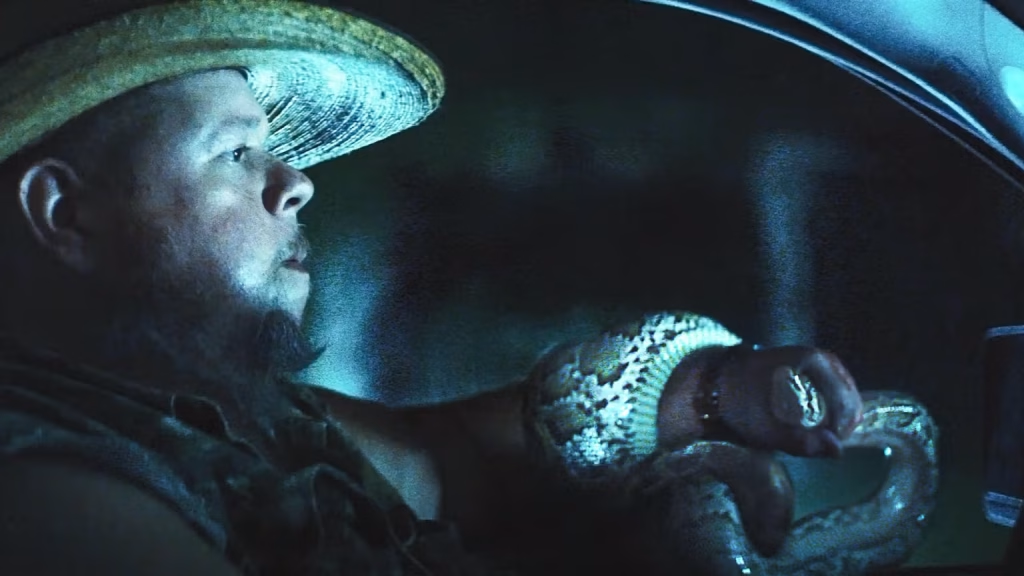
Characters star in ‘The Python Hunt’
Director Xander Robin, a 2008 graduate of Spanish River High School in Boca Raton, said “The Python Hunt” hatched from an earlier idea to make a scripted feature about the reptile trade in Florida.
His research led him, inevitably, to invasive Burmese pythons and their impact on the Everglades’ fragile ecosystem.
At the suggestion of friend and fellow director Lance Oppenheim (“Some Kind of Heaven”), Robin shifted his focus to shooting a documentary about the annual Florida Python Challenge, a 10-night event launched in 2013 by the Florida Fish & Wildlife Conservation Commission to eradicate pythons from state land. Each year, it attracts 850 to 1,000 participants competing for a $10,000 prize.
Robin participated in the 2022 and 2023 contests and made an inspiring discovery: The hunters were more interesting than the hunted.
“I was kind of surprised that it was 95% amateurs, not all professional bounty hunters,” he said. “They all want to be the next Steve Irwin.”
Among the many memorable characters in “The Python Hunt” is Richard, a science teacher from San Francisco who traveled to the Everglades on a vision quest. In one scene, marching through the swamp with a flashlight, he mentions that he “took a little nibble of ecstasy.”

Miss Anne, 82, a recently widowed nature lover who enjoys gin and tonic, brings a guide: tobacco-chewing outdoors journalist Toby Benoit, who says he’s an “eighth-generation Florida cracker.”
And there’s Jimbo, a transplanted New Jerseyan who’s so bitter about getting kicked out of a previous hunt over cheating allegations that he makes and plants fake pythons to fool contest participants.
“We cast a wide net. We had to have a handful of characters you can get invested in. I wish we could have included more,” said Robin, who said the process of editing 250 hours of footage into a 91-minute film was “maddening.”
“The Python Hunt” — which premiered at SXSW in 2025 and won a Special Jury Award — educates but mostly entertains.
“I was more interested in this slice of life,” Robin said. “We let the characters do the talking on the ecosystem of it all. I didn’t really want to make it too message-ey.”

Marjory Stoneman Douglas in the ‘River of Grass’
Director Sasha Wortzel, who grew up on Sanibel Island, said she made “River of Grass” knowing “that attacks on the environment are ramping up.”
Started in 2017 and finished in late 2024, her first documentary film would have a timely release in early 2025 — just months before the Alligator Alcatraz detention center popped up on the site of an airstrip in the Everglades. The history of that old airstrip gets essential screen time in her film.
“It was sort of uncanny, honestly,” she said of the detention center opening just months after the movie’s release.
The airstrip is the remnant of an aborted plan 55 years ago to build a massive jetport in what is now Big Cypress National Preserve — “this eerily parallel moment in 1969,” Wortzel said. Work on the jetport stopped in 1970.
The jetport episode led to the founding of Friends of the Everglades by Marjory Stoneman Douglas, the pioneering environmentalist who led the fight to stop the jetport and is the central figure of Wortzel’s documentary. Earlier this year, Friends of the Everglades was a co-plaintiff in a lawsuit to shut down Alligator Alcatraz.
“River of Grass” is a present-day imagining of Douglas’ groundbreaking book, “The Everglades: River of Grass,” which changed public perception of the area from worthless swamps to essential sources of freshwater.

Mixing archival interviews with Douglas and new footage from present-day Everglades leaders, such as Betty Osceola, Wortzel includes her own contributions, reading excerpts from Douglas’ book and joining Osceola on prayer walks to give the film the feel of a visual poem.
Wortzel started working on the project months after Hurricane Irma. Five years later, Hurricane Ian brought the film into focus. As Wortzel narrates in the film, Douglas came to her in a dream not long after Ian tore through the area on the west coast where the director grew up.
“Which she did,” Wortzel said. “She told me she needed to be in the film. That’s what led me to find the archival interviews, these incredible moments with her at home in Coconut Grove in her 90s, really just being fierce, unapologetic, and saying things that feel very, very resonant today, words that we still ended to hear.”
The film also features a mother taking on sugar industry pollution (including scenes from a rally outside the offices of Florida Crystals in downtown West Palm Beach), a Miccosukee environmentalist and poet, a family who have fished in the Everglades for six generations, and a mother-daughter team removing pythons.
“River of Grass” is an invitation for viewers to become more engaged in the environment, Wortzel said.
“I wanted to create a film that could really educate the public and also move people in an emotional way, give folks permission to feel their feelings, their grief, their anger about what’s happening,” she said.
(Editor’s note: Subtropic Film Festival co-founder José Jesús Zaragoza is a member of the Stet News Palm Beach County Community Advisory Board.)


Joe Capozzi is an award-winning reporter based in Lake Worth Beach. He spent more than 30 years writing for newspapers, mostly at The Palm Beach Post, where he wrote about the opioid scourge, invasive pythons, and Palm Beach County government. For 15 years, he covered the Miami Marlins baseball team. Joe left The Post in December 2020. He publishes the Lake Worth Beach Independent on Substack, covering the town where he lives.
